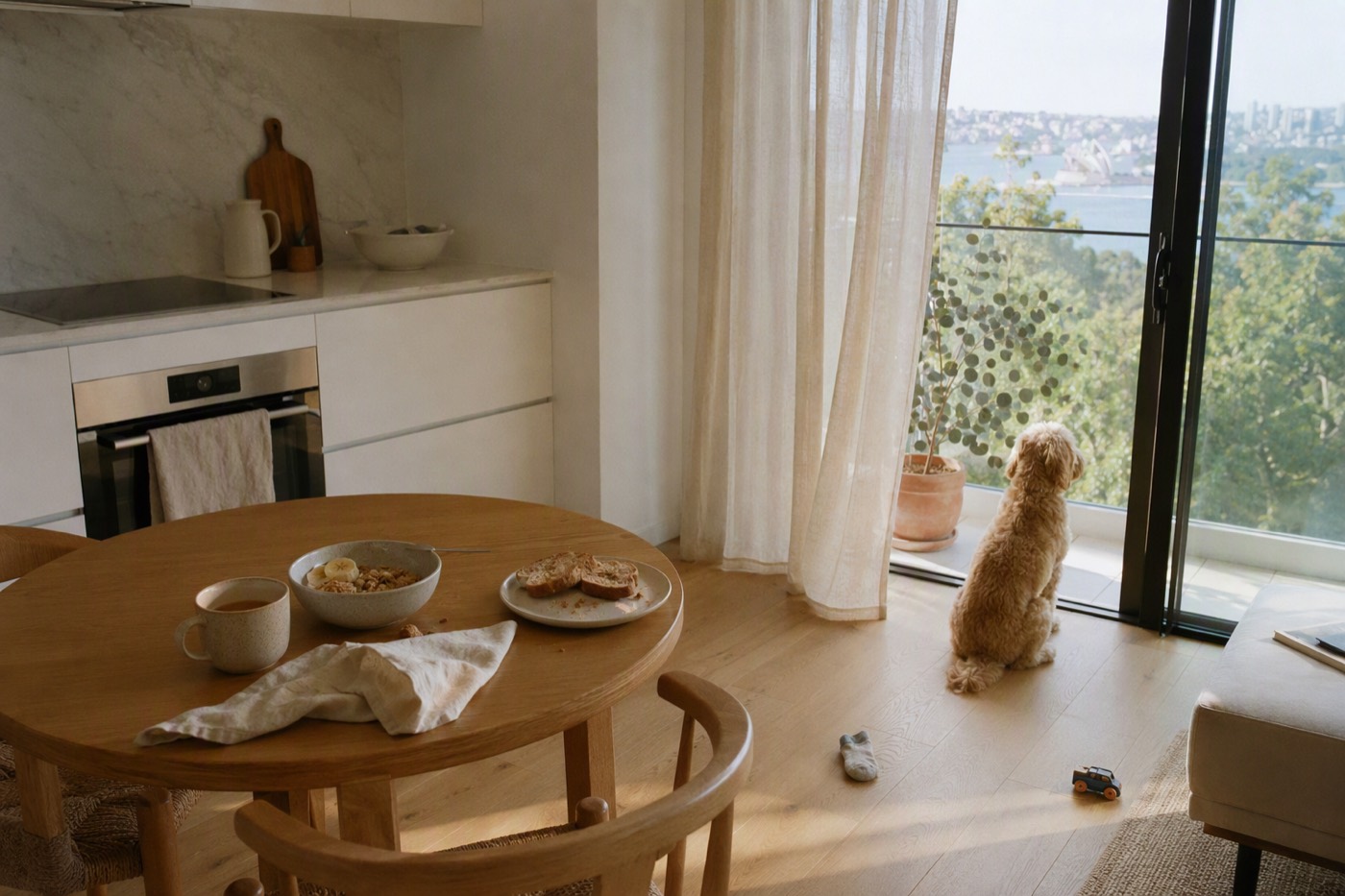
Our dog was here first, and when our toddler arrived, watching him figure out this new version of family life was one of the more quietly emotional parts of early parenthood. The movement became less predictable, the snacks infinitely more interesting, and the calm corners he’d claimed as his own suddenly had small hands in them.
We’ve learned a lot by watching what actually helps — for him and for us.
The first thing we had to get straight in our own heads: nobody here is doing anything wrong.
Toddlers are naturally unpredictable — sudden movements, squealing, dropping food, grabbing things, following the dog from room to room, and becoming utterly fascinated by tails, ears, food bowls and toys. That’s not misbehaviour. That’s being two.
And a dog isn’t being “bad” for finding some of it overwhelming. He’s just a creature whose entire routine got turned upside down by a small, loud, wonderful stranger.
Once you see it that way, the whole project changes. It’s not about fixing the dog or containing the toddler. It’s about helping two household members learn to share a home.
Give your dog somewhere they can disappear to
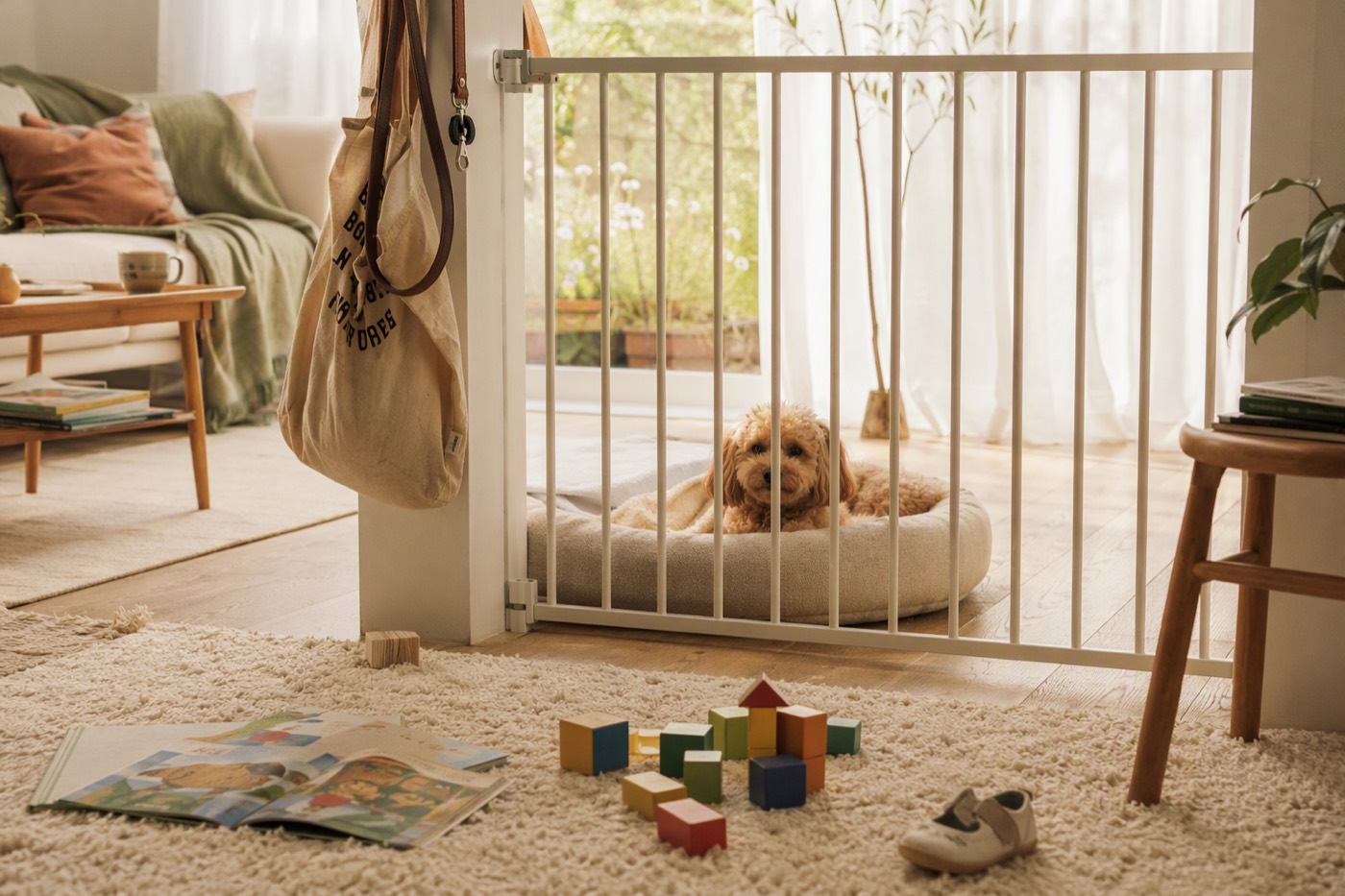
This was the first thing we got right. A bed behind a baby gate, a crate with the door propped open, a quiet corner of the bedroom — somewhere a toddler physically can’t follow.
The options matter less than the reliability:
- A dog bed behind a baby gate
- A crate, door open, in a family room
- A quiet room with a gate
- A corner of the house that’s genuinely the dog’s
- Any area separated by a secure barrier
And the important part: this shouldn’t be somewhere the dog gets sent when they’ve done something wrong. It should simply be somewhere they can choose to rest. Once our dog knew that space was reliable, he started using it himself. And that made everything else easier.
RSPCA guidance points the same way — make sure your dog has a safe place to retreat, and use physical separation so children and dogs can be apart when direct supervision isn’t possible.
Teach the toddler “dog rules”
It’s easy to frame the whole challenge as making the dog comfortable. But the other half of the question is just as useful: how do we teach our toddler to respect the dog?
Our little dog rules
- When the dog is eating We leave them alone
- When the dog is sleeping We leave them alone
- When the dog goes to their bed We give them space
- Always We don't pull tails or ears
- Always We don't climb on the dog
- Always We don't hug the dog
- Always We don't take the dog's toys or food away
- When the dog walks away We let them go
RSPCA guidance for families is the same list from the other direction: children shouldn’t disturb dogs while they’re eating, sleeping or resting, and dogs need breaks when they’re tired, unwell or overwhelmed.
Learn to read “I need space”
This is probably the most valuable thing any of us can learn, because dogs ask politely long before they ask any other way.
Your dog might be saying "I need space" if they…
- Turn their head away
- Avoid eye contact
- Lick their lips
- Yawn repeatedly
- Move away from the interaction
- Lower their body
- Hold their tail low
- Go stiff
- Try to leave
The one to remember
Don't wait for the growl before intervening. If the dog is already trying to move away, help them.
And when a dog does growl, resist the urge to shut it down. RSPCA advises against punishing growling, and it makes sense when you think about it — a growl is a warning, and the last thing you want is a dog who has learned to skip the warning. Suppressing the signal doesn’t fix whatever the dog is uncomfortable about.
Don’t force the relationship
The instinct is to narrate the friendship into existence. Look! Give the dog a pat! Say hello to Bella!
We try to teach the opposite: let the dog choose.
The dog comes over
Great
The dog walks away
Also great
The dog sits beside the toddler
Lovely
The dog prefers their own bed
That's okay too
RSPCA guidance is the same: let dogs approach on their own terms, and never force an interaction.
This is also where the “raising a kind child” part of the equation gets interesting. You’re not just teaching a toddler to be gentle with an animal. You’re teaching them that another living creature gets to have boundaries — that “no” doesn’t have to be a word to be respected. Toddlers who learn that about dogs tend to carry it into everything else.
Celebrate calm, not excitement
We tend to pay attention when the dog and toddler are interacting. But some of the best moments are when nothing happens:
A good afternoon, unremarkable on purpose
- The dog lies on their bed.
- The toddler plays nearby.
- Nobody grabs anyone.
- Nobody gets excited.
- Everyone carries on with their own little thing.
It’s the same principle behind the reward-based training RSPCA recommends — reward what you want more of, rather than only managing what you don’t. It’s easy to only notice the moments that need managing. The small good stuff is worth marking too.
Protect your dog’s old routines
Your dog had a life before the toddler. Try to keep pieces of it.
- Regular walks, at roughly regular times
- Normal meal times
- One-on-one attention that isn’t shared with anyone
- Their favourite sleeping spot, undisturbed
- Familiar toys
- Quiet time with you
The goal isn’t to guarantee your dog gets exactly the same amount of attention as before — that’s unrealistic with a toddler in the house. It’s simpler than that: give your dog some things that haven’t changed. Even ten minutes of uninterrupted, just-you time can hold a dog together through a chaotic week.
Give the toddler something else to do
Sometimes the easiest way to help the dog isn’t to train the dog at all. It’s to hand the toddler a better idea.
The dog is busy → here's what we can do
-
The dog is having a rest
“Let's read a book.”
-
The dog is eating
“Let's have our snack.”
-
The dog is playing with their toy
“Let's build our blocks.”
It gives the dog breathing room without anyone having to be in trouble — and it teaches a toddler that the dog doesn’t have to be part of every activity, which is a genuinely useful social lesson.
Coming home together
Coming home can be the most chaotic moment of the day: a tired toddler, bags everywhere, shoes, the pram, a dog who has waited all day and is extremely excited about it. Everyone wants attention at once.
We made it boring with a predictable sequence:
- Dog gets a calm hello first — ten quiet seconds
- Toddler gets settled — shoes off, snack spot, a task
- Bags get put away
- Everyone gets a moment to decompress before round two
Nothing complicated. Just the same order every day, so nobody has to guess what happens next. The calm hello at the start matters most — if the greeting is frantic, the next twenty minutes usually are too.
Learning to share a world
We used to think our goal was to help our dog get used to our toddler.
Now we think about it differently. We’re trying to help them learn how to share a home.
Our toddler is learning that the dog has boundaries. Our dog is learning that those little hands don’t always mean chaos. And we’re learning to watch both of them a little more carefully.
Sometimes they play together. Sometimes they sit in the same room doing completely different things. Sometimes the dog quietly walks away and our toddler carries on with their blocks.
And honestly, those quiet moments might be the ones we value most.
They don’t have to be best friends every minute. They just need to feel safe, respected and comfortable sharing the same little world.